

If you've worked in supported living for any length of time, you've almost certainly heard the word "outcomes".
Funders ask about them.
Commissioners want evidence of them.
Trustees want reports demonstrating them.
Yet despite how often the term is used, there is still a surprising amount of confusion about what outcomes actually are.
Many organisations are doing incredible work every day, but struggle to clearly demonstrate the difference they are making because activities, outputs and outcomes become blurred together.
Understanding the distinction is one of the most important steps any supported living organisation can take towards improving reporting, demonstrating impact and ultimately delivering better services.
This post is the first in our series, Measuring What Matters: A Practical Guide to Outcomes in Supported Living.
Why outcomes matter
At its core, supported living exists to help people make progress.
That progress might look different depending on the individual.
For one person it may mean developing independent living skills.
For another it may mean securing stable accommodation.
For someone else it could mean improved mental wellbeing, entering employment or building stronger community connections.
Whatever the goal, organisations need a way of understanding whether the support they provide is actually helping people move forward.
That's where outcomes come in.
Outcomes help answer a simple but important question:
"What difference has our support made?"
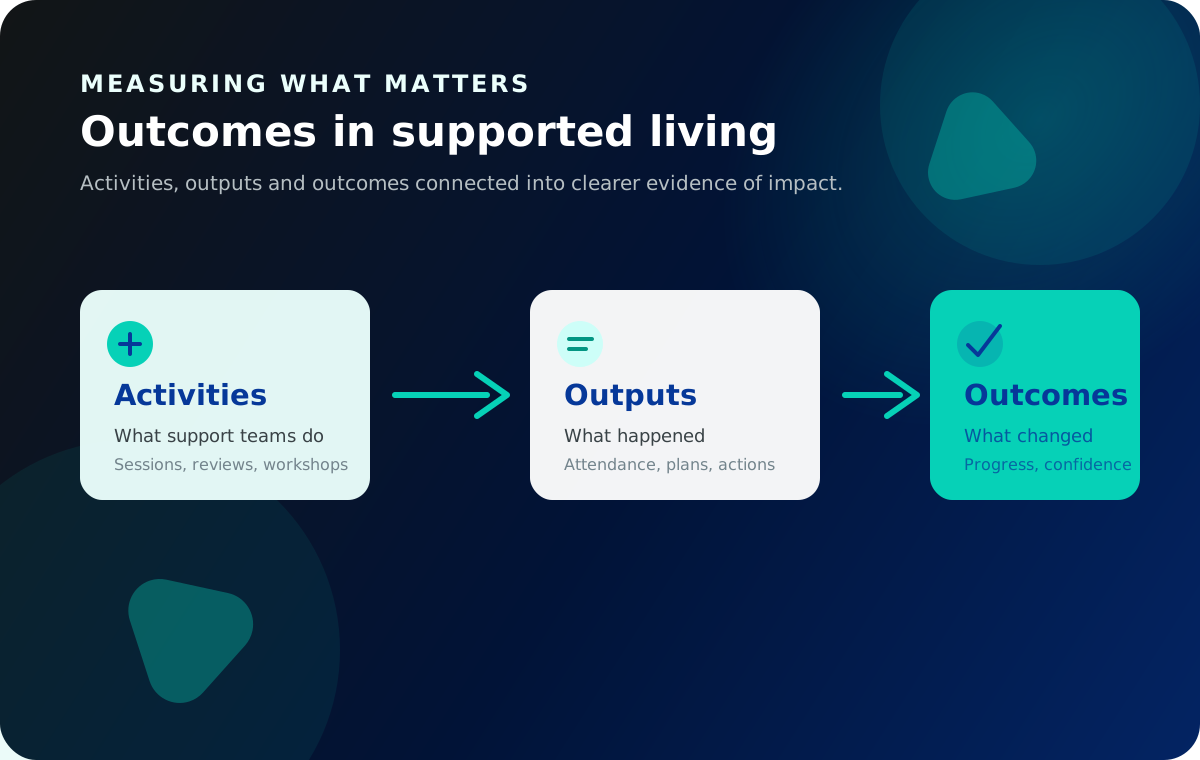
Activities, outputs and outcomes
One of the easiest ways to understand outcomes is to compare them with activities and outputs.
Activities
Activities are the actions your organisation carries out.
Examples include:
- One-to-one support sessions
- Housing advice meetings
- Skills workshops
- Wellbeing sessions
- Support plan reviews
Activities describe what you do.
Outputs
Outputs are the immediate results of those activities.
Examples include:
- 50 support sessions delivered
- 20 people attended a workshop
- 15 support plans reviewed
- 10 appointments arranged
Outputs tell us what happened.
They are useful, but they don't tell us whether anyone's life improved as a result.
Outcomes
Outcomes are the changes experienced by the individual.
Examples might include:
- Increased confidence
- Improved budgeting skills
- Reduced isolation
- Better emotional wellbeing
- Greater independence
Outcomes tell us what changed.
And that's what makes them so important.
Why outputs aren't enough
Many organisations are excellent at reporting outputs.
They can tell you:
- How many people they supported
- How many sessions they delivered
- How many referrals they received
Those figures are valuable.
But on their own they don't demonstrate impact.
Imagine two organisations both reporting that they delivered 500 support sessions during the year.
Without understanding outcomes, it's impossible to know whether those sessions led to meaningful change.
The number of sessions delivered matters.
The difference those sessions made matters more.
Outcomes don't need to be complicated
Sometimes organisations avoid outcome measurement because it feels too complex.
They imagine large frameworks, complicated scoring systems or extensive reporting requirements.
In reality, good outcome measurement often starts with simple questions:
- Is the individual making progress?
- What has improved?
- What challenges remain?
- What evidence supports that conclusion?
You don't need hundreds of indicators.
You need meaningful indicators.
Outcomes should reflect your mission
Every organisation is different.
The outcomes that matter most should reflect the purpose of the service.
For example, a youth support organisation may focus on:
- Education
- Employment
- Confidence
- Life skills
A homelessness service may focus on:
- Housing stability
- Financial management
- Community integration
- Wellbeing
A rehabilitation programme may focus on:
- Recovery
- Stability
- Positive relationships
- Long-term independence
The important thing is ensuring that outcomes align with the support being provided.
Outcomes create better conversations
One of the biggest benefits of outcome measurement is that it shifts conversations away from activity and towards impact.
Instead of asking:
"How many sessions did we deliver?"
Organisations begin asking:
"What difference did those sessions make?"
That change in perspective often leads to better decision-making, better services and ultimately better outcomes for the people being supported.
Outcomes support funding and growth
Funders increasingly expect organisations to demonstrate impact.
Being able to clearly show progress can strengthen:
- Funding applications
- Trustee reporting
- Stakeholder engagement
- Strategic planning
More importantly, it provides confidence that resources are being used effectively.
Final thoughts
Activities are important.
Outputs are important.
But outcomes are what truly matter.
Supported living organisations exist to create positive change in people's lives.
Understanding outcomes helps organisations demonstrate that change, learn from it and continually improve the support they provide.
The goal isn't simply to record what happened.
The goal is to understand whether lives are moving forward as a result of the support being delivered.
And that's a conversation worth having.