

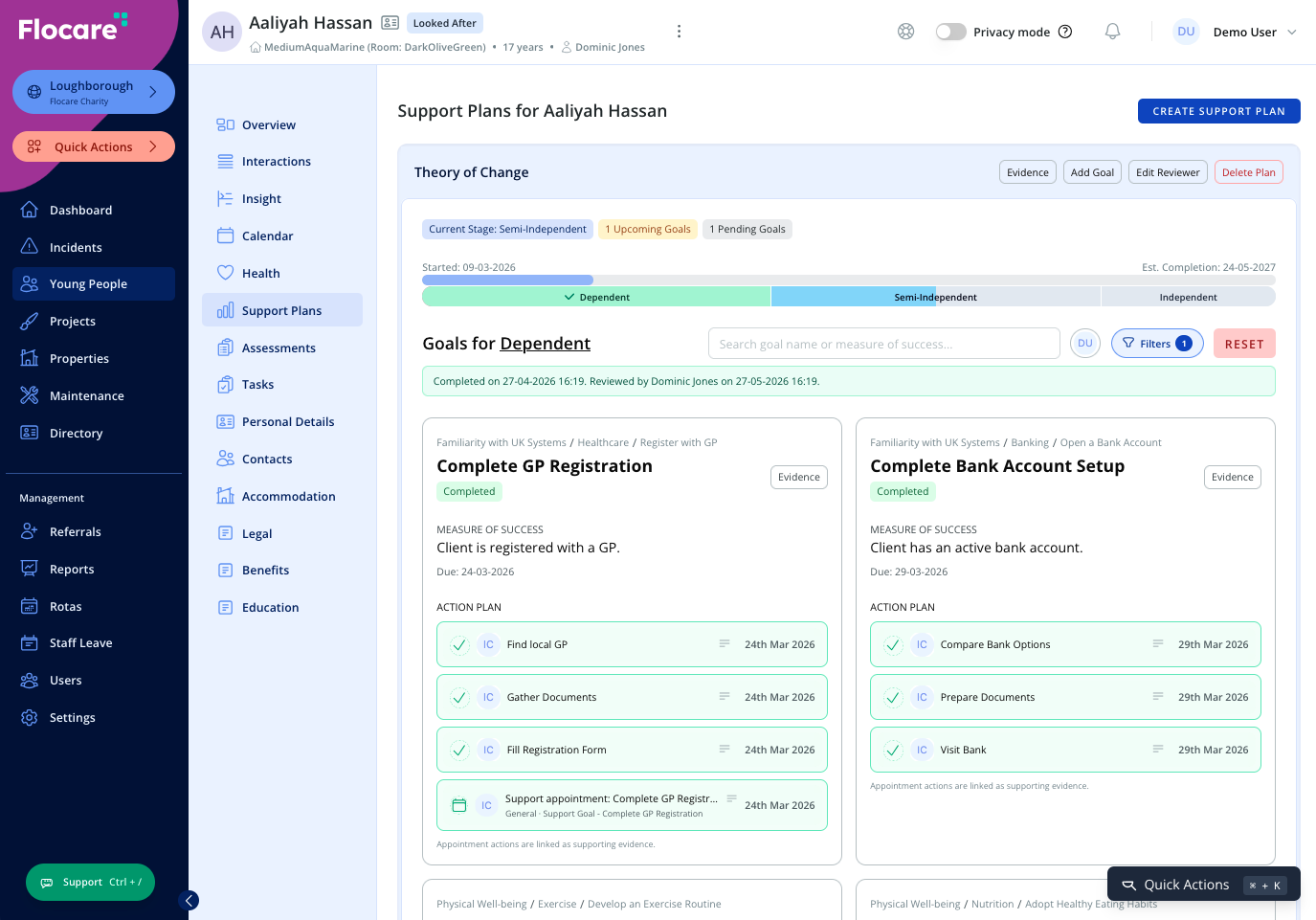
Support plans sit at the centre of good supported living. They help staff understand a person’s needs, goals, risks, preferences and day-to-day support arrangements. At their best, support plans are living documents that guide practical support and help teams evidence progress. At their worst, they become static files that are updated before a review and ignored during everyday work.
The difference usually comes down to how connected the plan is to the reality of support. A good support plan should not be a form completed once and stored away. It should help staff make better decisions, understand what matters to the person, and connect daily activity to outcomes.
What is a support plan?
A support plan is a structured record of how someone should be supported. In supported living, that might include daily living skills, health needs, emotional wellbeing, education or employment goals, safeguarding considerations, communication preferences, relationships, appointments, accommodation needs and progress towards independence.
A useful support plan normally answers questions such as:
- What matters to this person?
- What support do they need day to day?
- What are their goals or desired outcomes?
- What risks need to be understood and managed?
- What does good support look like for them?
- How will the team know whether progress is being made?
Support plans are also important for consistency. Staff may work different shifts, cover different services or support someone during a crisis. The plan should help them understand the current picture quickly and safely.
Why support plans often lose value
Many organisations have support plans, but not all support plans actively shape daily work. Common problems include plans being too long, too generic, out of date, disconnected from notes, or written in language that is not useful to frontline staff.
A support plan loses value when staff do not trust it. If the plan does not reflect recent changes, staff will rely on memory, messages or informal handovers. That creates risk because important context can be missed.
Another common issue is evidence. A plan might include a goal such as building confidence with appointments, improving budgeting skills or preparing for independent living. But if daily notes are not connected to that goal, it becomes difficult to show what progress has been made.
What makes a support plan useful?
A useful support plan is practical, specific and reviewable. It gives enough detail to guide support without becoming so dense that staff avoid reading it.
Good support plans are usually:
- Person-centred, using language that reflects the individual.
- Clear about what staff should do and why.
- Specific about risks, triggers, preferences and strengths.
- Connected to goals, outcomes and review evidence.
- Updated when circumstances change, not only at formal reviews.
- Easy for authorised staff to find and understand.
It is also important to separate useful detail from noise. Staff need to know what is current, what has changed and what actions matter most. A long document is not necessarily a better plan.
Connecting support plans to daily evidence
Support planning becomes more powerful when it connects to daily records. If a person is working towards a goal, the team should be able to record relevant updates and later understand progress without manually searching through disconnected notes.
For example, if a young person is working towards managing appointments independently, useful evidence might include:
- Appointments attended.
- Prompts or support required.
- Missed appointments and reasons.
- Confidence or anxiety before and after appointments.
- Follow-up actions agreed with the key worker.
- Any change in independence over time.
This kind of evidence helps reviews become more meaningful. Instead of asking staff to reconstruct progress from memory, the organisation can use records created through normal support work.
Support plans and reporting
Many supported living providers need to report progress to funders, commissioners, families, social workers or internal leadership teams. Support plans can support reporting if goals and daily evidence are linked.
The key is to avoid treating reporting as a separate exercise. If the information needed for reporting is only gathered at the end of the month or before a review, managers spend time chasing updates and interpreting scattered notes.
Better reporting starts earlier. It starts with clear goals, structured updates and consistent recording. The support plan gives the framework. Daily notes and actions provide the evidence. Reviews and reports then become easier to prepare.
Keeping plans current
A support plan should change when the person’s needs, risks or goals change. That sounds obvious, but in busy services the update process can become delayed. Staff may know that something has changed, but the written plan may not reflect it.
To keep plans current, organisations should agree:
- Who owns the plan.
- When it should be reviewed.
- What changes require an immediate update.
- How staff should flag that a plan may need revision.
- How updates are communicated to the wider team.
Digital systems can help by making plans easier to access, review and connect to related records. But the process still needs clear ownership.
Questions to ask about your current support plans
If you are reviewing your approach, start with these questions:
- Can staff find the latest plan quickly?
- Does the plan reflect the person as they are now?
- Are goals connected to daily evidence?
- Can managers see when plans are overdue for review?
- Are changes communicated clearly to relevant staff?
- Does the plan help support workers make better decisions?
- Can progress be evidenced without manually searching multiple systems?
If the answer to several of these questions is no, the issue may not be the idea of support planning. It may be the way plans are stored, updated and connected to everyday work.
Key takeaways
Support plans should be practical working tools, not static documents. They are most valuable when they guide daily support, connect to evidence and make reviews easier to prepare. For supported living providers, the goal is not simply to have a completed plan. The goal is to create a shared, current understanding of how each person should be supported and how progress is being made.
A strong support plan helps staff act consistently, helps managers review quality, and helps organisations show the impact of their work.